
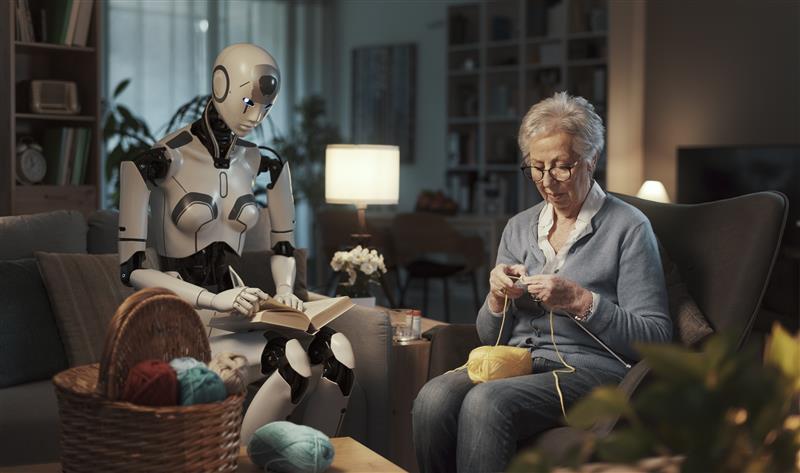
It is often ironic how yesterday’s science fiction rapidly transforms into today’s science fact. Technology we once dismissed as too outlandish to be real is now part of our daily routine, ranging from personal computers and smartphones to autonomous vehicles and artificial intelligence. The lesson for the modern era is clear: we should not be too hasty in dismissing notions that seem far-fetched today.
Enter the potential era of the robot caregiver.
In the face of a rapidly aging population and a shrinking workforce of human medical professionals, it is only a matter of time before high-tech caregiving catches on. This was our primary takeaway after reviewing a fascinating report from the BBC that first surfaced last fall. In the original article, BBC science correspondent Pallab Ghosh explores some of the most recent robotic developments emerging from the UK and Japan.
The general conclusion of current research is that while the industry is in its infancy regarding physical care, high-tech caregivers will likely become a permanent part of the healthcare landscape soon. With that in mind, let’s take another look at the current state of the art in robotic caregiving. (Please note that we have edited portions of the BBC material for brevity, and we encourage you to read the original report online for more detail.)
The Goal: Designing Helpers Rather Than Terminators
Ghosh begins his article with a particularly evocative image of current engineering. He describes a lab in northwest London where black metal robotic hands move with an eerie precision on an engineering workbench. These hands lack claws or pincers, featuring instead four fingers and a thumb that open and close slowly with joints in all the right places.
While this may seem like an intimidating vision, Rich Walker, the director of the robotics firm Shadow Robot, is quick to offer a lighter perspective. He clarifies that they are not trying to build a “Terminator” style machine. Instead, the goal is to build a robot that makes life better as a general-purpose servant that can handle housework and home tasks.
Addressing the Global Caregiving Crisis
According to Ghosh, the deeper ambition of these projects is to address a serious crisis in the UK and beyond. There is an escalating shortage of human caregivers that requires a technological intervention.
Ghosh writes that there were 131,000 vacancies for adult care workers in England according to a report by the charity Skills for Care. Furthermore, around two million people aged 65 and over in England are currently living with unmet care needs. By 2050, one in four people in the UK is expected to be aged 65 or older, which will place even more strain on the existing care system.
Government Investment in Autonomous Care Systems
This move toward automation is not merely a niche interest for tech enthusiasts. The previous government in the UK invested heavily in caregiving robotics, contributing over £34 million to the cause. Officials explained in 2019 that autonomous systems will become a normal part of life within the next 20 years, transforming how we live and travel.
However, Ghosh poses the fundamental question that many of us likely share regarding this transition. He asks if this is truly the solution and whether people would trust themselves or their elderly relatives with a powerful machine during their most vulnerable moments.
Japan as a Testing Ground for Robotic Integration
For a cultural example of how humans and robots might coexist, Ghosh turns our attention toward Japan. A decade ago, the Japanese government began offering subsidies to robot manufacturers to popularize their use in care homes. This move was fueled by an aging population and a relative lack of available care home staff.
Dr. James Wright, an AI specialist and visiting professor at Queen Mary University of London, spent seven months observing three specific types of robots in a Japanese care home. The three models studied were known as HUG, Paro, and Pepper.
Comparing the Designs of HUG, Paro, and Pepper
The HUG robot, designed by Fuji Corporation, functions much like a sophisticated walking frame. Ghosh explains that it features support pads that residents can lean into, helping caregivers lift people from beds into wheelchairs or toward the bathroom.
In contrast, Paro was designed to look like a baby seal to provide emotional stimulation for dementia patients. This robot was trained to respond specifically to touch, movement, and sound. Finally, Pepper was a humanoid robot with a friendly appearance designed to lead exercise classes by demonstrating arm movements.
When Hype Meets the Reality of Daily Care
Before observing these robots in action, Dr. Wright confessed that he had initially bought into the marketing hype. He expected that the robots would be easily adopted by overstretched care workers. However, his findings in the field were almost the exact opposite of that expectation.
He found that the time required to clean, recharge, and maintain the robots became the single biggest drain on the staff’s schedule. After several weeks, many care workers decided the machines were more trouble than they were worth and stopped using them.
The physical logistics also proved difficult, as the HUG robot had to be moved constantly to stay out of the residents’ way. Paro caused emotional distress to one resident who became overly attached, and Pepper’s exercise routines failed because the robot was too short for people to see clearly.
Developers Refine Designs Based on Field Research
The developers of these care robots have been responsive to Dr. Wright’s observations and have implemented changes based on his research. Ghosh writes that the creators of HUG have since refined the design to be more compact and user-friendly for tight spaces.
Paro’s creator, Takanori Shibata, noted that the robot has been used for 20 years and pointed to trials demonstrating clinical evidence of therapeutic effects. As for Pepper, the robot is now owned by a different company and has received substantial software updates to improve its performance and utility.
Understanding the Priorities of Elderly Users
Praminda Caleb-Solly, a professor at the University of Nottingham, is working to make caregiving robots more practical for the real world. Her network, known as Emergence, helps connect robot manufacturers with the businesses and individuals who will actually use the technology.
She emphasizes the importance of getting these robots out of the laboratory and into actual homes. Her network has asked elderly individuals directly what they want to see in a helper robot, and the answers often vary based on personal preference.
Some people requested robots with voice interaction and a non-threatening or “cute” appearance. However, many requests focused on practical adaptability and the ability for the robot to charge and clean itself without human intervention. As one respondent noted, they want the robot to look after them, not the other way around.
Mixed Results in UK Real-World Testing
Other organizations, such as the home care provider Caremark, are also testing robotic services in limited trials. They have been experimenting with a small voice-activated robot called Genie to see how it integrates with daily care.
While there have been some positive responses to Genie, the overall reactions from users have been mixed. Some individuals have enjoyed the interaction, while others have been less complimentary about the experience. Caremark director Michael Folkes stresses that these robots are not meant to replace humans, but rather to give human caregivers more time to provide quality care.
The Necessity of Human-Like Dexterity
Back at the Shadow Robot Company, Rich Walker has identified mastering a functional robotic hand as one of the biggest hurdles. He explains that for a robot to be truly useful, it must have the same ability to interact with the world as a human.
The specimen shown to Ghosh was constructed from metal and plastic and fitted with 100 sensors to mimic human strength and dexterity. The fingers can move smoothly and precisely, and the hand can even solve a Rubik’s Cube one-handed. However, it is still a long way from performing delicate tasks like using scissors or picking up fragile objects.
Concerns Over the Economic Impact on Caregivers
Dr. Wright shared one final concern regarding the widespread adoption of robots in the medical field. He worries that if they catch on, they might actually make life harder for human caregivers by driving down wages or standardizing care homes in a way that feels industrial.
He argues that the economic drive to make robots work might result in care workers being paid minimum wage just to service the machines. This would be the opposite of the vision where robots give time back to caregivers to spend quality, conversational time with their residents.
Preparing for an Automated Future
Despite these concerns, other experts maintain a more optimistic view of the coming automation. Gopal Ramchurn, a professor of artificial intelligence, believes this will become a massive industry given the current workforce deficit and the growing demand for elderly care.
As the CEO of Responsible AI, Ramchurn is involved in ensuring that these systems remain safe, reliable, and trustworthy. He points to the development of robots like Elon Musk’s Optimus as evidence that this future is approaching rapidly whether we are ready or not.
By anticipating this future now, experts hope to develop the right rules and ethics before big tech companies deploy these systems on a massive scale. As Ramchurn suggests, we need to be ready for that future today.
Rajiv Nagaich – Your Retirement Planning Coach and Guide
Rajiv Nagaich’s newest program on PBS, called Designing Your Ideal Future, is bringing Rajiv’s powerful message to Americans from coast to coast. This engaging and challenging PBS show is prompting thousands to take a fresh look at the type of planning that will help them succeed in retirement.
In this one-hour PBS special, Rajiv Nagaich takes viewers step-by-step through the principles of creating a retirement plan that truly supports the life you want to live. Instead of generic check-the-box paperwork, Rajiv reveals how to infuse your perspective — your values, goals, and priorities — into every legal document and life plan component so your plan becomes a living system for your future.
Designing Your Ideal Future includes insights from real-world planning examples and a live Q&A with Rajiv Nagaich that answers viewer questions about retirement planning, legal readiness, and family communication. It’s perfect for anyone approaching retirement, currently retired, or responsible for a loved one’s future care — and for those who want a clear, effective approach to planning that prioritizes personal choice and quality of life.
What about you?
You’ve heard Rajiv say it repeatedly: 70 percent of retirement plans will fail. If you know someone whose retirement turned into a nightmare when they were forced into a nursing home, went broke paying for care, or became a burden to their families – and you want to make sure it doesn’t happen to you – then these materials are your key to retirement success.
Visit your local PBS station’s schedule to find airtimes and learn how to access companion resources — including a free Legal Readiness Quiz and tools to help build your complete LifePlanning system.
Don’t remain among the millions of Americans sleepwalking their way into a retirement they never wanted. Instead, your retirement can be the exciting and fulfilling life you’ve always hoped it would be. Start by watching, reading and sharing Rajiv’s important message.
And remember, Age On, everyone!
The post The Future of Elder Care: Can You Trust a Personal Robot Caregiver? appeared first on Home.
